Let me be direct with you. The Copilot Studio $200 monthly pack looked like a reasonable enterprise AI entry point when your team was running three pilots with fifteen users each. It stops looking that way at 3,000 users — and the gap between those two realities tends to close faster than anyone forecasts.
The problem is predictable and the math is simple, yet most organisations reach the conversation about cost governance only after their first invoice shock. By that point they're already committed to the architecture that generated the cost — and optimising it means re-engineering agents that are already in production, managing change-fatigue in teams that just finished an implementation, and making the case for more budget in the same meeting where they're explaining why the last allocation ran out.
There is a better path. It's an architectural one, not a pricing negotiation. So let's talk about the reality.
The $200 Pack Isn't the Problem. The Architecture Is.
The $200 monthly pack delivers 25,000 message capacity — which sounds substantial until you understand what a "message" actually costs in a real enterprise deployment.
Each agent interaction involves significantly more than a single LLM call. Depending on your agent configuration, a single end-user turn can trigger:
- A retrieval call to your grounding source — SharePoint, Dataverse, or external APIs — adding token overhead per retrieval chunk before the LLM sees anything.
- One or more LLM inference passes for reasoning, response generation, and potentially a separate summarisation pass if the retrieved content is long.
- Azure Content Safety evaluation if configured — a separate API call that contributes to both latency and cost on every interaction.
- Conversational context inflation — multi-turn sessions pass the full history on every turn, meaning your 10th message in a session carries 9 previous turns of token overhead.
For a basic FAQ bot answering predictable questions with a shallow knowledge base, this is manageable. For a complex enterprise agent — one grounded in large SharePoint libraries, running multi-turn sessions, doing actual reasoning across documents — the cost-per-session profile is an order of magnitude different.
An organization deploys a SharePoint-grounded legal research agent for 200 lawyers. Each session is a multi-turn deep dive. They're through their monthly credit pack in three days.
The issue isn't that the pack is too small. It's that the default architecture treats every task identically — routing every interaction through the same frontier model at the same cost, regardless of what the task actually requires. A policy lookup costs the same as a ten-page legal document synthesis. That's not a billing problem. It's a design problem.
The Fix Isn't Cheaper Models. It's Smarter Routing.
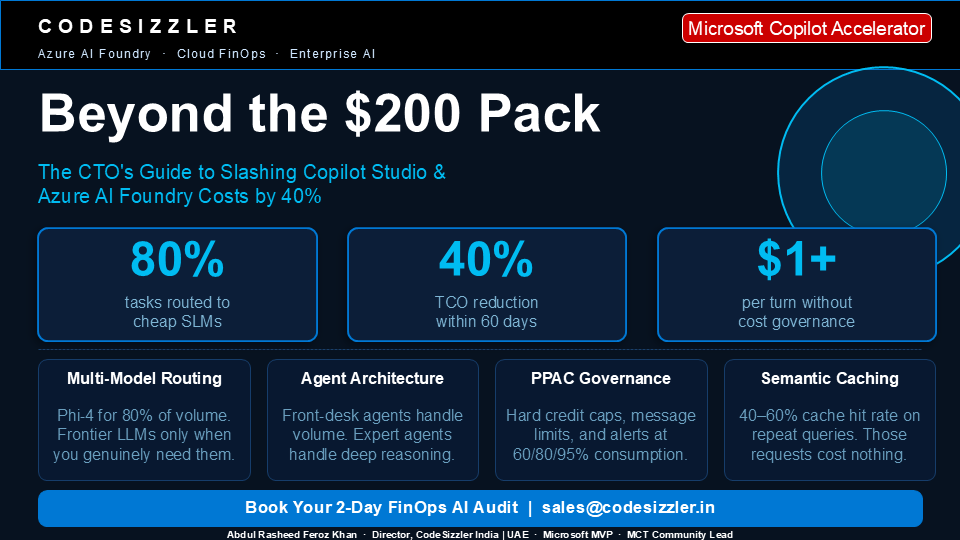
The solution that consistently delivers 40% TCO reduction across our enterprise deployments is multi-model routing. The core principle: not every task requires a frontier LLM. And the savings compound when you stop pretending otherwise.
| Task Type | Examples | Model | Approx. Cost/Turn |
|---|---|---|---|
| Simple triage & FAQ | Policy lookup, HR queries, status checks, routing | Phi-4 (SLM) | $0.001–0.003 |
| Mid-tier analytical | Summarisation, structured extraction, moderate Q&A | GPT-4o mini | $0.008–0.02 |
| Complex reasoning | Legal analysis, multi-doc synthesis, compliance review | GPT-4o | $0.04–0.10 |
The insight that changes the economics is this: in most enterprise Copilot Studio deployments, 70–85% of interactions are tasks a significantly cheaper model handles well. FAQ lookups, policy queries, status checks, structured data retrieval, basic routing decisions — none of these require GPT-4o. They require fast, accurate, cost-efficient inference.
Implementing multi-model routing effectively requires four things:
- Intent classification at the front-door agent — classify incoming sessions before any expensive inference happens. Route to the appropriate agent tier based on detected task complexity.
- Agent topology separation — deploy a front-desk agent (Phi-4 or GPT-4o mini) for high-volume routine queries and a separate expert agent (GPT-4o) for deep reasoning tasks with documented requirements.
- Confidence-threshold escalation — when the front-desk agent encounters ambiguity above a configured threshold, route to the expert agent rather than attempting a degraded response.
- Per-model cost monitoring in Azure Monitor — track cost by agent, by model, and by interaction pattern over rolling 30-day windows. Model routing rules need tuning as usage patterns mature.
Copilot Studio Governance: The Part Most Teams Skip
Multi-model routing optimises cost at the architecture layer. Power Platform Admin Centre (PPAC) governance controls it at the environment layer — preventing runaway consumption before it becomes a billing event. Most teams implement neither until after the first unexpected overage charge.
The governance configuration that makes a practical difference:
- Hard credit caps per environment — set absolute monthly limits per environment so a single runaway bot cannot consume capacity allocated to other workloads.
- Message limits per bot per month — configure individual bot consumption ceilings independent of environment-level caps, giving you per-agent visibility and control.
- Consumption alerts at 60%, 80%, and 95% thresholds — alert the engineering team at 60%, alert the platform owner at 80%, and trigger a review gate at 95% before the bot is silently throttled.
- Per-channel routing rules — assign different capacity pools to different deployment channels. Your Teams bot and your customer-facing web widget should draw from separate quotas.
- Environment-level quota assignment — allocate credit pools by environment tier (prod, staging, dev) with production receiving a protected allocation that non-production environments cannot touch.
PPAC governance doesn't reduce your baseline cost — it protects the savings you've engineered at the architecture layer from being eroded by unexpected usage spikes, misconfigured agents, or a bot that goes unexpectedly viral in your organisation.
Where the 40% Actually Comes From
The 40% TCO reduction isn't a single lever. It's a compound of six optimisations that each deliver modest savings individually and meaningful savings together. Here's what the breakdown typically looks like across our enterprise deployments:
| Optimization Lever | Mechanism | Estimated Savings |
|---|---|---|
| Multi-model routing | Route 80% of volume to Phi-4 / GPT-4o mini instead of frontier LLMs | 25–35% |
| Semantic caching | Cache embeddings and responses for repeat query patterns — no LLM call required | 10–15% |
| Agent decomposition | Separate front-desk agents (SLM) from expert agents (frontier LLM) by task type | 8–12% |
| PPAC hard caps | Prevent runaway consumption events that inflate monthly actuals | 5–8% |
| RAG optimisation | Tune chunk sizing and top-k retrieval to reduce tokens per grounding call | 5–8% |
| Batch offloading | Move non-real-time workloads off Copilot Studio to lower-cost Azure AI pipelines | 3–6% |
Combined reduction: 38–47%, depending on workload composition. Most deployments land around 40% within the first 60 days.
The range exists because workload composition varies significantly. An organisation with a large proportion of simple FAQ interactions will see savings weighted towards multi-model routing and caching. One with complex, document-intensive agents will see more benefit from RAG optimisation and batch offloading. The first step in any cost governance engagement is characterising your actual usage distribution — without that data, savings estimates are guesswork.
The CodeSizzler Approach
CodeSizzler is a Microsoft Solution Partner and certified Copilot Accelerator. We have run AI cost governance engagements across enterprise clients in insurance, banking, healthcare, and professional services — and the pattern is consistent: teams that architect for cost from the start spend significantly less at scale than teams that optimise retroactively.
What we've learned across these engagements is that cost governance isn't a one-time configuration exercise. It's an ongoing architectural discipline that requires instrumentation, review cadences, and the willingness to revisit model assignments as workloads evolve. The organisations that do it well treat it the same way they treat security or reliability: as a first-class design concern, not an afterthought.
We've codified our approach into a structured 2-Day FinOps AI Audit that gives enterprise teams the cost baseline, architecture recommendations, and governance configuration they need to hit the 40% target — and maintain it as they scale.
2-Day FinOps AI Audit
The audit is designed to move fast and deliver actionable output — not a lengthy report that sits in a shared folder. Here's what we cover:
- Day 1 — Discovery: Architecture review (current agent topology, model assignments, grounding strategy), cost baseline from Azure billing and estimated credit burn rate, usage pattern analysis (peak loads, turn distribution, top-5 high-cost flows), and PPAC environment audit against recommended governance configuration.
- Day 2 — Recommendations: Multi-model routing architecture (which tasks move to SLMs and exactly why), caching strategy (which query patterns qualify and estimated hit rate), agent decomposition plan (front-desk vs expert agent boundary and handoff design), PPAC governance configuration (caps, alerts, per-environment limits), and a projected savings model at conservative, expected, and optimistic scenarios.
You leave with a prioritised implementation roadmap, not a whitepaper. The recommendations are specific to your architecture, your usage data, and your organisational constraints — not generic best practices that may or may not apply to your deployment.
👉 Ready to cut your Copilot Studio costs by 40%?
Book Your FinOps Audit